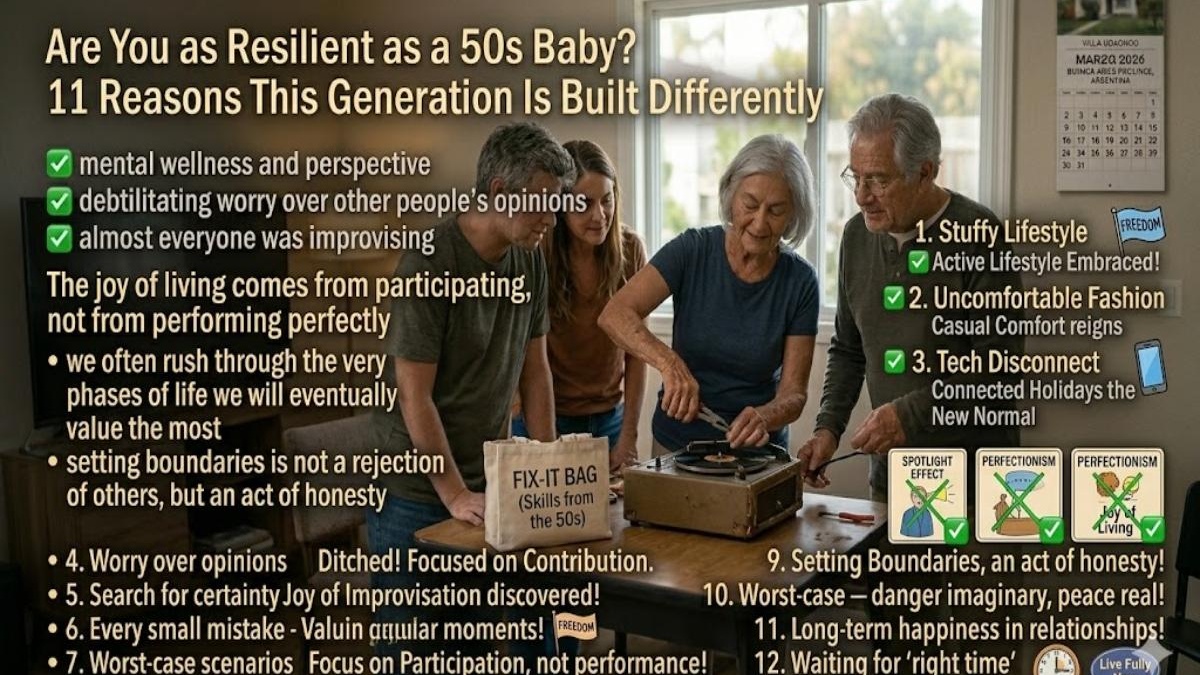
As a health and lifestyle expert based in the U.S., I’ve spent decades studying how our formative years dictate our long-term physical and mental “fitness.” We often talk about biological aging, but there is a functional strength—a psychological and social “muscle”—that seems uniquely developed in the generation born during the 1950s. While research by professor Peter Gray notes that the 50s saw a slight dip in “independent adventure” due to the rise of television, this demographic still mastered the art of autonomy in ways today’s “tracked and monitored” youth simply cannot.
These individuals grew up in an era where solving problems, managing profound boredom, and supporting the family unit weren’t suggestions—they were survival requirements. From walking to school without a GPS-tagged smartphone to running household errands solo, people born in the 1950s are independent at their core, having developed a sense of self-esteem and resilience that doesn’t rely on external validation. In adulthood, this translates to a generation that doesn’t expect the world to protect their comfort; they’ve spent a lifetime protecting it themselves.
The Architecture of Resilience: Risk, Patience, and Accountability
Growing up without overbearing “helicopter” parents meant that 1950s children had to learn to assess risk in the moment. Whether they were exploring the woods or babysitting younger siblings at age ten, critical thinking was a daily necessity. This wasn’t “gentle parenting” where emotions were constantly centered; it was a “sink or swim” environment that forced this generation to embody patience and emotional regulation long before mental health apps existed. They understand the art of waiting—a skill that has made them masters of delayed gratification in a world of instant hits.
This background also created a legendary level of accountability. In a 1950s household, the parents were the undisputed authority, leaving zero room for excuses. This has produced adults who don’t flake on commitments; their loyalty and “showing up” mentality are ironclad. As psychology professor Jason Whiting points out, making excuses sabotages trust, but this generation prioritizes action over explanations, understanding that physical and emotional presence is the foundation of any healthy relationship or career.

Furthermore, being forced to manage their own boredom without screens turned this group into innovators. Because they had to fill their own time, they don’t run from quietness or discomfort. Experts from the Child Mind Institute suggest that this ability to sit with one’s own company is critical for cognitive development. This explains why the 1950s generation remains remarkably imaginative and self-reliant, viewing an empty afternoon as an opportunity for creativity rather than a problem to be solved with a scroll through a feed.
Literal competence is another hallmark of this era. Growing up with a “fix it before you replace it” mentality, these individuals learned tangible life skills—from basic plumbing to complex cooking—out of necessity. They are inherently self-sufficient because they had to be. This competence, combined with a natural inclination toward privacy and emotional stability, means they don’t need a “like” button to know they are doing a good job; they formed their values in their own private spaces, away from the prying eyes of the internet.
Socially, this generation possesses a “hidden” strength in face-to-face interaction. In the 50s, managing conflict and making friends were manual processes. You had to look people in the eye and navigate social hierarchies in person. A study in Nature Human Behavior highlights that these social behaviors lead to happier, healthier lives. Because social interaction was an obligation rather than an option, Boomers have the community-building skills that are increasingly rare in a world dominated by digital avatars.
Perhaps most importantly, they are masters of the present moment. Without the constant pull of a smartphone, they learned the value of active listening and deep attention. Whether in a boring school lesson or a family dinner, they were taught that respect is shown through eye contact and focus. This innate ability to be attentive and present allows them to build deeper connections and maintain higher concentration levels than younger generations who have been “conditioned” by the rapid-fire dopamine hits of modern tech.
Ultimately, the challenges faced by those born in the 1950s—though sometimes harsh—acted as a forge for a specific type of human strength. They are a generation of “fixers” and “doers” who understand that life’s greatest rewards usually require a bit of waiting and a lot of personal responsibility. As our culture continues to shift toward a digital-first existence, the “analog” skills of the 50s baby remain a powerful blueprint for what it truly means to be a resilient, capable human being.