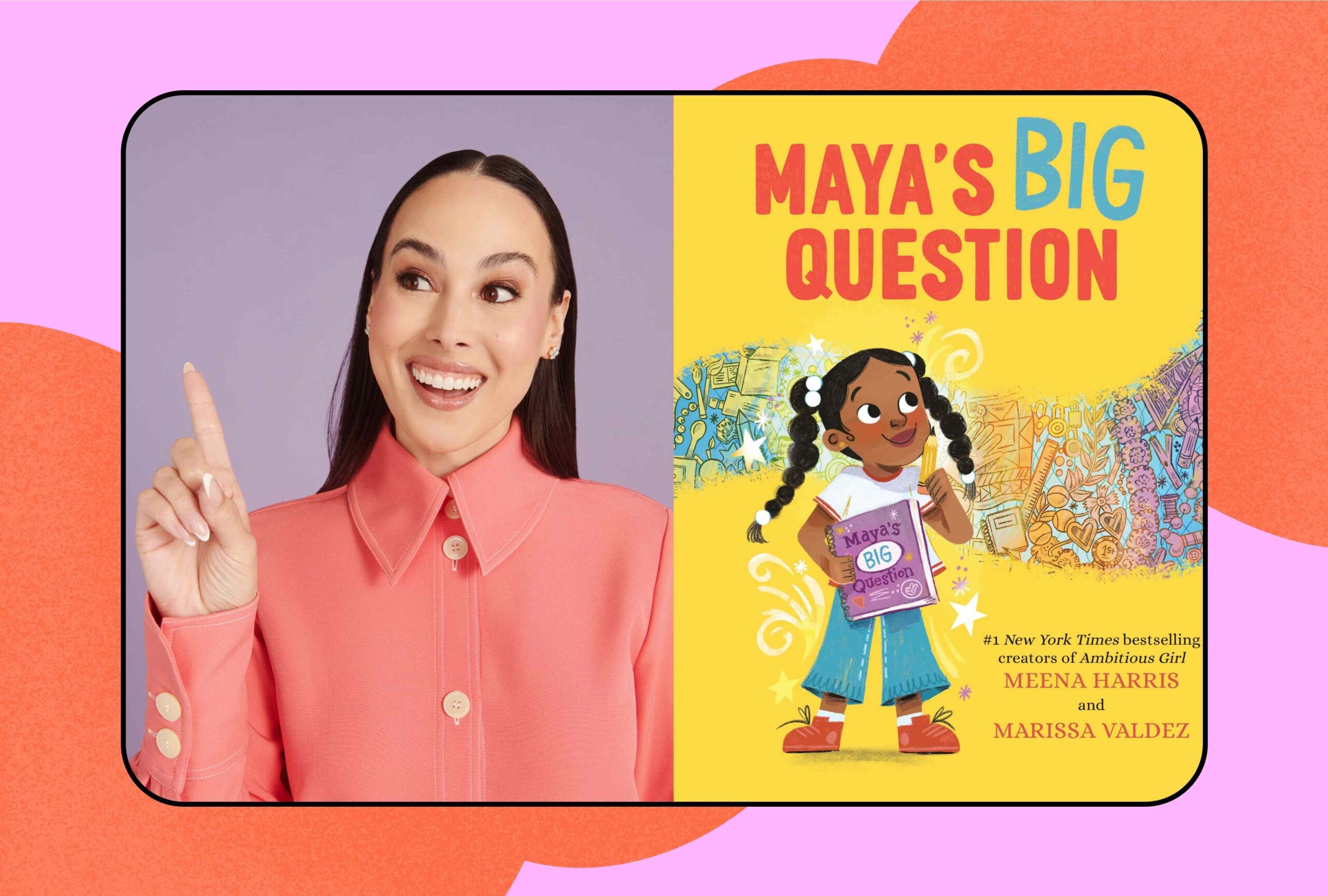
The lawyer and children’s book author celebrates female representation in ‘Maya’s Big Question,’ just in time for Women’s History Month.
Just in time for Women’s History Month, Meena Harris’ latest book for young readers, Maya’s Big Question, is encouraging kids to think critically about women’s rightful place in history. In what she says could be considered an unofficial sequel to her first book, Kamala and Maya’s Big Idea, Harris’ protagonist goes on a class trip to Washington, D.C., and realizes that all of the monuments she visited solely honor men.
“When I first wrote this book, I was really thinking about the heated debates that we are having around public monuments and these questions of who are our heroes, who deserves to be immortalized, what do monuments say about our values?” explains the author, lawyer, and founder of Phenomenal Media.
Combining those questions with her signature themes of girl power, women’s equity, and female representation led Harris to her protagonist’s big questions: “Where are all the women? Why is there no female representation in our monuments?”
By centering her fifth book around this specific quandary, the mom of two wants young readers to know that there’s power in asking questions.
“The bigger goal—and the way I hope that the book is used as a real tool—is getting kids to question the status quo,” says Harris. “If because of your specific experience or your specific observation, you notice something that you have a unique question around, that is incredibly powerful. Ask all kinds of questions and understand that there’s incredible power in doing that, especially if no one else is asking that same question.”
“The bigger goal—and the way I hope that the book is used as a real tool—is getting kids to question the status quo.”
Meena Harris
How ‘Maya’s Big Question’ Took Her Writing to the Next Level
Harris feels like her path to becoming an author was quite unexpected. “I wrote my first book as a side creative project while I still had a corporate job and no plans of leaving that job,” she recalls. “It was very much paying tribute to my grandmother and the values of community organizing, teamwork, and bettering your community that I wanted to pass onto my own children.”
Now, five books later, Harris sees Maya’s Big Question as a way for her to get back to the style she launched with Kamala and Maya’s Big Idea, while simultaneously evolving her work.
“I took the learnings from the first book and thought about, ‘OK, how do I add nuance to this or keep building?’” says Harris. “Part of that was getting so much great feedback from educators and teachers and around how they were really using my book as a tool. It’s nice to know it’s having the impact that I intended.”
Getting Inspiration From Her Upbringing and Daughters
With Kamala and Maya’s Big Idea, Harris aimed to pay tribute to her grandmother, Shyamala Gopalan, who was a pioneering scientist, researcher in the field of breast cancer, and mom to former Vice President Kamala Harris.
Now, her childhood and family continues to fuel her writing titles that celebrate female empowerment, leadership, and heroes.
“Everything I do is inspired by the family I was raised by, and the family I’m now raising,” says Harris.
She explains, “The family I was raised by was unique—just being surrounded by incredible women—and I only kind of came to realize the power of that when I became a mom. For me, my worldview was that women were the main characters…the people who were in charge.”
In turn, it’s important for Harris to not only raise her daughters Amara, 9, and Leela, 8, the same way but to make that perspective and those values accessible to others through her books.
At the same time, Harris was inspired to address a lack of representation and diversity in children’s books—something she noticed was seriously missing when she first became a new mom nearly a decade ago.
“We’ve made incredible progress since then, but back when I started off, there were more books that had animals as main characters than Black, Indigenous, Hispanic, all people of color,” she notes. “And of those books that had human characters, in the majority of them, white boys were the main characters. And I knew that I wanted to write books that had little Black girls as main characters.”
Harris set out to center characters like Maya for both girls and boys.
“It’s not just about having daughters,” she points out. “It’s also incredibly important for boys to see that representation matters, having that mirror matters, but so does having windows into other people’s experiences in terms of child development around empathy.”
Encouraging Kids to Ask Big Questions
Though Harris says she’s just trying her best like everyone else, the author encourages who want their kids to develop theircritical thinking skills to speak honestly with them, talk to them about current events, and encourage them to ask questions.
Taking this approach makes Harris think of how her family never had a kids’ table for Thanksgiving. She sees that choice as a metaphor for holding space for kids’ to share their ideas. And when kids ask questions, as they’re apt to do because they’re curious and observant, can validate them by taking them seriously and engaging with them, explains Harris.
“It’s not about treating kids like adults, but it’s more about respect for them and respect for the questions that they may have,” notes Harris.
For example, Harris has been engaging with her eldest daughter on climate change, allowing her to head up their conversations. “I have a perspective on that and care a lot about it, but I’m letting her lead and recognizing that she’s going to have a unique experience in her generation, and the way that she has come into engaging that issue is different than how I did,” she says.
By empowering her girls to tap into their innate curiosity, Harris is also encouraging them to trust themselves. “If somebody’s saying, ‘The sky is green,’ and you’re like, ‘No,’ understand that there’s power in pushing back on that.”
Read the original article on