The 34-second viral video has sparked intense debate about whether customers should face consequences for ignoring safety protocols
A TikTok video showing a Lowe’s customer moving safety barriers to grab pillows despite repeated employee warnings has ignited a massive debate about customer accountability. The 34-second clip, posted to X by user @DrAlmarielao yesterday (March 7), shows a female customer entering a blocked-off aisle after an employee explicitly warned her that “something might fall on your head.” The video has already racked up over 3.2 million views, 8,235 likes, and more than 3,000 replies.
The incident occurred in the home goods section of a Lowe’s store, where an employee had set up a blue-and-red expandable barrier with yellow caution signs to safely move heavy items. Additionally, the employee repeatedly tried to stop the customer from entering the restricted area, but she dismissed his warnings and proceeded to grab multiple pillows from the shelves. Meanwhile, viewers are divided on whether the customer should be permanently banned from the store.
Follow Hip-Hop Vibe on MSN for more news and information
What the Safety Barrier Setup Looked Like
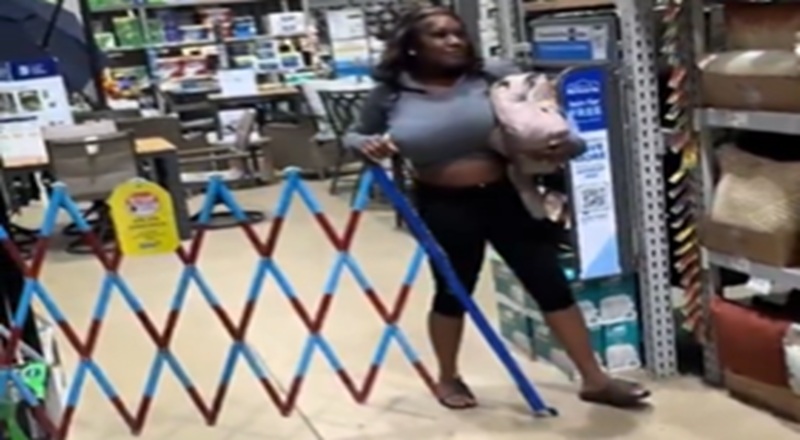
The footage, originally posted on TikTok by user @myhoneyeysnacks, shows a zigzag expandable gate stretching across the aisle entrance in the home goods section. Yellow caution signs are clearly attached to the barrier, warning customers to stay out. The barriers are standard retail safety devices used during restocking or when operating machinery like forklifts and lifts for overhead items.
The blocked-off aisle contained pillows, blankets, and other soft goods stocked on mid-to-high shelves, approximately 4-6 feet off the ground. Above these items, heavier boxed goods or fixtures could potentially fall if disturbed. According to OSHA data, falling objects cause thousands of injuries annually in warehouses and stores, which is why retail safety protocols require barriers during hazardous activities.
A female customer wearing a gray top, black pants, and sandals approached the barrier carrying a purse. Without hesitation, she bent down and moved the barrier aside, stepping into the restricted aisle despite the clear warnings.
Employee Warns Her 10 Times That Something Could Fall
The employee, wearing a Lowe’s vest, immediately called out to the customer as soon as she entered. “Ma’am, ma’am please, ma’am?” he said urgently. As she continued walking deeper into the aisle, he raised his voice. “Wait! Do not… ma’am this is dangerous do not come in here.”
Throughout the 34-second interaction, the employee issued at least 10 verbal warnings. He explained the danger multiple times, called for assistance, and repeatedly asked her to leave. “You cannot come across the thing,” he pleaded, gesturing toward the barrier on the ground.
As the customer reached for higher shelves, the employee became more insistent. “Something might fall on your head,” he warned, pointing upward. The warnings escalated as she continued grabbing items. “I’mma have to ask you to leave. Please, it’s dangerous back here.”
The employee never physically touched the customer or escalated the situation beyond verbal warnings. Additionally, he appeared to call for help via radio while continuing to explain the risks. No items fell during the incident, but the video shows shelves shifting slightly as the customer reached for pillows.
Customer Dismisses Warnings and Mocks Employee
The customer only responded about five times throughout the encounter, with dismissive and casual remarks. “Honey I can get a pillow down,” she said when first warned, reaching for a pillow on a mid-level shelf. As the employee continued pleading, she responded: “So I want to help somebody,” seemingly unbothered by the safety concerns.
When he warned that something might fall on her head, she grabbed a third pillow and said, “Hold on let me get a few pillows.” Her tone remained sarcastic and casual throughout, showing no concern for the potential danger or the employee’s frustration.
As she finally walked out of the aisle with multiple pillows in her arms, she glanced back at the employee. “Okay do more that’s cute,” she said mockingly. The employee reset the barrier, looking visibly frustrated as the video ends. The footage doesn’t show any resolution, such as security involvement or whether the customer faced immediate consequences.
Why Retail Safety Barriers Exist
Retail safety barriers like the one at Lowe’s serve a critical purpose in preventing accidents. When employees stock high shelves or move heavy inventory, they use ladders, lifts, or spotters to safely access items. Customers entering these areas bypass these protocols and put themselves at risk.
Heavy items stored above eye level can shift or fall if lower items are removed without proper support. Additionally, employees operating machinery like forklifts need clear zones to prevent collisions or dropped loads. The barriers create a protective perimeter that keeps customers safe while allowing employees to complete dangerous tasks.
From a legal standpoint, customers who ignore safety barriers could void liability claims if an injury occurs. Legal precedents in negligence cases show that disregarding clear warnings can shift responsibility away from the store. Therefore, the customer in this video could have been held personally responsible if something had fallen and hurt her.
Lowe’s safety policies, like those of similar retailers, require employees to block off aisles during hazardous activities. The protocols exist to protect both customers and workers from preventable accidents.
X Reactions Split on Who’s to Blame
The video sparked intense reactions on X, with over 3,000 replies by press time (March 8). The most common response called for the customer to be banned from the store. “Remove her from the store & bar her from ever returning,” one comment said, receiving 219 likes. A Lowe’s employee wrote: “As a Lowe’s employee stuff like this irritates me. I think they should face consequences.”
Many criticized the customer’s entitled behavior. “The sense of entitlement these days is so frustrating,” one comment with 219 likes stated. One of the most-liked responses used humor: “People like this is why we have warning labels on shampoo bottles,” garnering 975 likes.
However, some blamed Lowe’s for blocking aisles during business hours. “Stores used to do that late late at night. Store’s fault because they don’t want to pay overtime,” one comment with 109 likes argued. Another wrote: “Lowe’s should stock the shelves in off hours. If you want to inconvenience shoppers they won’t come back.”
A significant portion of replies questioned whether the video was staged. “Fake vid too convenient to have the camera rolling already,” one user wrote. Another comment gained traction accusing the video of being racially motivated: “Shout out to the content creators who staged this video to capitalize off of the white supremacist’s anti-Black racism,” receiving 398 likes. However, the Lowe’s employee was a Black man.
Retail Workers Share Similar Experiences
Former and current retail workers flooded the replies with personal stories of customers ignoring safety protocols. “I hated when people did this when I worked at Lowe’s like this shit can tumble over,” one person shared. Another wrote about working at Lowe’s and dealing with similar entitled behavior regularly.
The frustration among retail workers was evident across replies. “People can be so damn rude,” one former employee commented. Multiple workers emphasized that customers intentionally ignore warnings hoping to get injured so they can sue the company. “They INTENTIONALLY want to get hurt so they can SUE the company,” one highly-engaged reply stated.
These personal accounts highlight a broader pattern of customer behavior in retail environments where safety warnings are dismissed as inconveniences rather than legitimate concerns. Additionally, workers noted that stores are often reluctant to enforce consequences, leaving employees powerless to stop dangerous behavior.
Conclusion
The viral Lowe’s video has become a flashpoint for debates about customer entitlement, retail safety, and accountability. The customer’s decision to ignore clear barriers and at least 10 verbal warnings to grab pillows has drawn widespread criticism, with many calling for permanent bans on customers who disregard safety protocols.
The employee’s calm but persistent warnings highlight the difficult position retail workers face when customers refuse to comply with safety measures. As the video continues to spread across social media platforms, the question remains: should customers face real consequences for ignoring safety barriers, or is a verbal warning enough?
The post Customer moves safety barrier at Lowe’s despite employee warning her something could fall on her head, so she could grab pillows [VIDEO] appeared first on Hip Hop Vibe.
Follow Hip-Hop Vibe on MSN for more news and information
Related Headlines
- Woman charged with attempted murder after shooting at Rihanna’s Los Angeles home
- Jill Scott announces dates for “To Whom This May Concern” World Tour
- Gunplay goes off on Rick Ross: “I was a Day 1.. You and Def Jam played ping pong with my career!” [VIDEO]
- Fans break out into a massive fight at State Farm Arena after Hawks defeat Sixers [VIDEO]